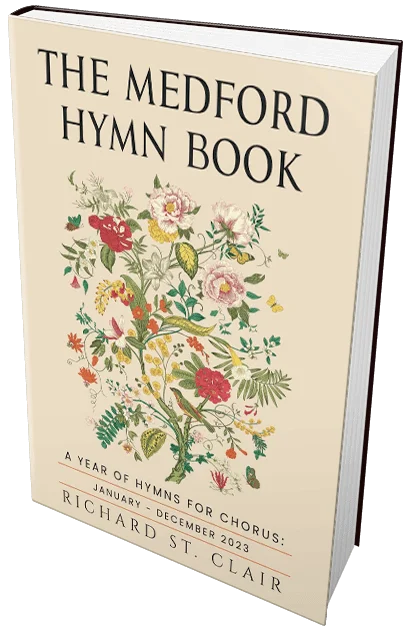
The Medford Hymn Book
215 Original Hymns
A collection of 215 four-part a cappella hymns. Original melodies, harmonizations, and, in 130 cases, texts, composed in Medford, Massachusetts.
View the published cover +
Original cover artwork from Richard’s catalogue. Check the retailer for the current edition.
More about this edition +
The Medford Hymn Book is a collection of 215 four-part hymns for a cappella chorus in Bach-influenced chorale style with rich harmonic/melodic discourse. The authors are many and varied, spanning several centuries. Richard St. Clair has written both melody and harmonic arrangement for all the hymns in this collection. In addition to texts by other spiritual writers, he has written the text of 130 of the 215 hymns.
St. Clair writes,
“The Medford Hymn Book, named after the city I lived in while composing the music (viz. Medford, Massachusetts), is a collection of 215 four-part a cappella hymns in which the music (and in 130 cases the text as well) is by the present composer of this collection (myself), assembled over most of the year 2023.
“I became immersed in writing hymns in my own free harmonic style and sharing them with a dear old friend, Bill Harwood of Vermont in Christian fellowship with him, as he fought but ultimately lost his battle with an atypical cancer late in 2023. I felt a special kinship in these hymns with Bill, through my almost daily hymns for which he always kindly expressed appreciation. It was a special bond I’ll never forget. one that could not have happened without modern technology like email and music software, as we lived in two different cities in two different states.
“I have discovered that I have a spiritual calling to compose musical hymns, in the stylistic way in which I have gone beyond the Bach principles of chorale writing and incorporated unorthodox, though singable, voice-leading and surprising musical moments. Thus the music owes its existence to the style blazoned by J. S. Bach, in his church cantatas, infused with a more contemporary approach to harmony and melody as well as tessitura and spacing.”
Join the conversation.
Reflections, performance experiences, and thoughtful questions are welcome.
Reader comments will open here when the new site launches.